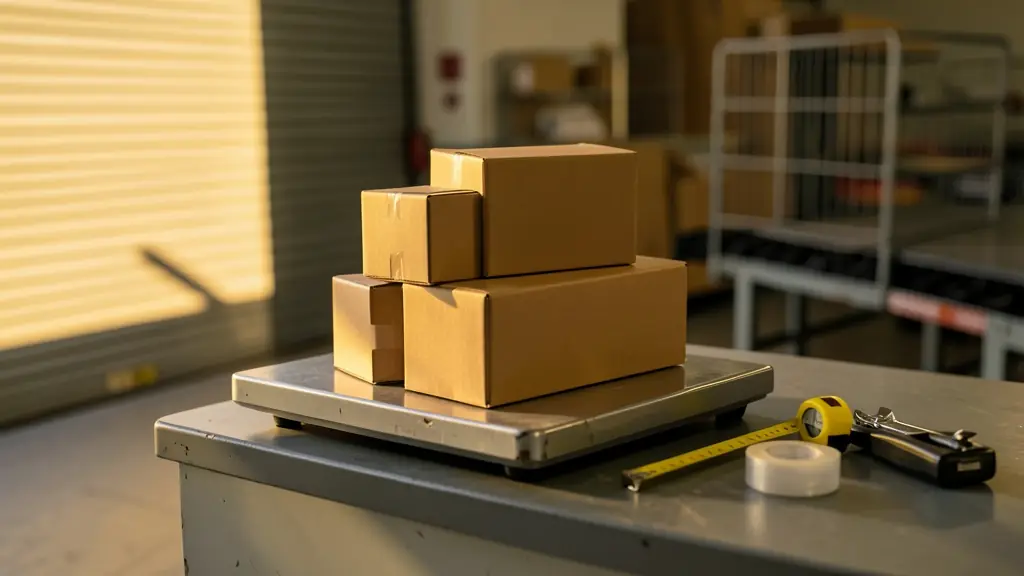
The online seller in Randburg who ships pillows learns this fast: a big light box is billed on its size, not its mass. To calculate volumetric weight, multiply the length, width and height in cm and divide by the carrier's figure. This tool does it for each box and the whole shipment, so you know the chargeable weight before you book courier services or air freight.
The divisor each carrier uses
The divisor turns cm³ into kg. The tool starts with the usual figures, and you can change any of them to match a quote:
- Courier and express: 5000, so a cubic metre counts as 200 kg.
- Air freight: 6000, about 167 kg a cubic metre.
- Road part loads: 4000 is one courier's road figure, but depots each set their own and many price by the pallet instead. Ask.
- Sea LCL: one CBM counts as one ton, and you pay on whichever is more.
Chargeable weight in one example
Three cartons of 60 x 40 x 40 cm at 8 kg each. Each carton is 96,000 cm³, so by courier it counts as 19.2 kg against its real 8 kg. The three are billed on about 57.6 kg, not 24. By air the same boxes count as 16 kg each. Carriers usually round each box up to the next half or whole kg, so a shipment of many small boxes can come out a little higher than the tool shows.
How to bring the number down
Pack to the product, not to the box you have. Cut down tall cartons, use one bigger box instead of five half empty ones, and skip the air pillows that only fill corners. Measure after packing, at the widest point, with any handles or bulges included: the depot scanner will. If the chargeable weight still beats the real mass by far, a part load on a pallet may cost less than courier parcels.
Using it in a quote request
Put the size of each box, the real mass and the count in your request, not only the total kg. The carrier works out its own chargeable weight and the quote will match what you are billed. Say whether the boxes can be stacked and whether someone helps at collection.
Frequently asked questions
How do I find volumetric weight by hand?
Measure the box in cm, multiply length x width x height, then divide by 5000 for courier or 6000 for air. Compare the answer with the real mass on a scale: the bigger of the two is what you pay for.
Why was my parcel charged more than it weighs?
Because the carrier billed on size. A light, bulky parcel takes space a heavier one could use, so its volumetric weight wins. Check the box sizes on the invoice against what you measured.
Does road freight use volumetric weight?
Often, but each carrier sets its own figure, and many charge part loads per pallet or per CBM instead. For a full truck it hardly matters: you pay for the truck. See freight rates for how road loads are priced.
Do you carry the parcels?
No. We carry, collect and deliver nothing ourselves. Send one request with the box sizes and masses, and couriers and transporters who serve your route quote you directly.
Read more
More tools
- CBM and container calculatorCartons or pallets with sizes, mass and count in: the total CBM, the mass and how full a 20 foot, 40 foot or high cube is out
- Truck size and pallet calculatorPallets, mass each, pallet size and loose freight in: the smallest truck that takes it, by floor and by payload, out
- Freight cost calculatorFrom, to, truck, return leg, tolls and extras in: the km, the fuel and a rough rand range for the load out
- Import duty and VAT calculatorInvoice value, currency, incoterm, freight, insurance and duty rate in: the customs value, duty, import VAT and landed cost out
- Incoterms chartAn incoterm or two to compare in: who pays each leg, from packing to unloading, and where the risk passes out