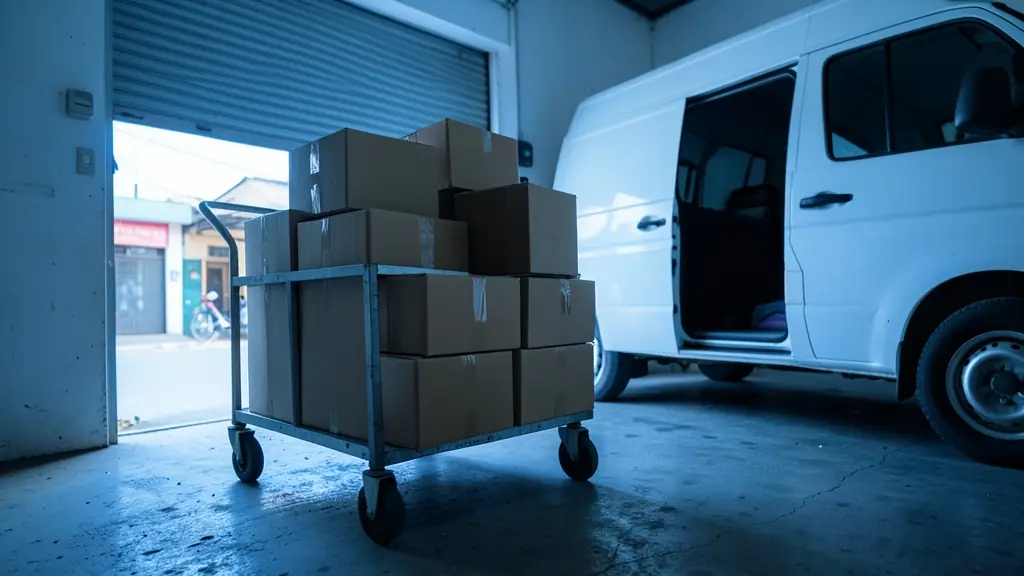
Courier services move parcels and documents from one door to another, usually priced per parcel on the greater of the real or the volumetric mass. In South Africa you choose between same day in one city, overnight between the main centres and slower economy road, and the price gap between them is wide. Send one request and independent couriers that serve your towns quote you directly.
Price guideAbout R70 for a local small parcel and R86 to R120 overnight within Gauteng, rising to about R359 overnight on national main routes. Same day in one Gauteng metro starts at about R90A rough guide from published South African prices. Route, mass, dates, diesel, handling and VAT all move it.
Same day, overnight and economy road
Same day courier services send a driver on a bike, a car or a small van straight from you to the receiver inside one metro, so you pay for the trip, not the parcel. Overnight courier services run parcels through a hub to Johannesburg, Durban, Cape Town, Pretoria, Gqeberha and Bloemfontein for delivery the next working day. Economy road takes two to four days and suits anything that is not urgent. Regional towns such as Upington, Mthatha or Musina often add a day or two whichever option you choose. International courier is a separate quote, and duty and VAT are charged on arrival.
Why a light box can cost more than a heavy one
Couriers charge on chargeable mass: the real mass or the volumetric mass, whichever is higher. To get volumetric mass, most couriers multiply the three sides in cm and divide by 5000, so a 60 x 40 x 40 cm carton of duvets counts as about 19 kg even if it weighs 4 kg. Use a box that fits the goods, cut down tall cartons and check the figure with the volumetric weight calculator before you book.
Rates for online sellers who send every day
A seller dispatching 80 parcels a day should not pay counter rates. Ask for an account rate based on your monthly volume and the size mix, a daily collection time that leaves room to pack, and labels printed from your own system. Ask what a failed delivery costs, how many redelivery attempts are included and whether a parcel can wait at a counter or locker. Cash on delivery means the courier collects the money and pays it over to you later, less a fee, so ask when.
When a courier is the wrong choice
Couriers are built for parcels a person can lift. Three pallets of stock, a fridge or a 70 kg crate usually cost less as a part load on a truck: see freight consolidation or road freight. Bulk stock that leaves in small orders may belong in warehousing with a pick and pack service.
Who asks for this
- Private people
- A birthday box to a grandchild in George, or a laptop back to the repairer.
- Shops and online sellers
- Daily collections of online orders with labels printed from the store system.
- Factories and plants
- Spare parts and samples sent overnight to a customer whose line has stopped.
- Farms and packhouses
- Seed samples to a lab, or a pump part rushed out from the city.
- Mines and quarries
- A small urgent spare flown or driven up before the next shift starts.
- Builders and contractors
- Plans, keys and a box of fittings to a site in another province.
- Importers and exporters
- Small express shipments from overseas that clear on arrival with duty and VAT.
- Hauliers and owner drivers
- A replacement sensor for a truck standing at a depot far from home.
Frequently asked questions
Who quotes me when I ask for courier services near me?
Independent couriers and same day delivery firms that collect in your area. They get your details from us and send you their own prices. We collect, carry and deliver nothing ourselves.
Where do I find cheap courier services in South Africa?
Cheaper rates usually come from economy road, dropping parcels at a counter or locker instead of a collection, tight packing and a volume account. A rate that leaves out fuel levies or VAT is not cheap, just incomplete.
Is my parcel covered if it is lost or damaged?
Most couriers include limited cover and let you declare a higher value for an extra charge. Read what is excluded: glass, electronics and poor packing are common reasons for a refused claim.
Will a courier take batteries, perfume or gas canisters?
Often not, or only under special terms, because many of these count as dangerous goods. Tell the courier exactly what is inside before you book; see dangerous goods transport for larger amounts.